











Garage Floor Rugs: The Complete Guide to Durable, Oil-Resistant Mats and Runners
Partager
Garage floor rugs have to survive things no living room rug will ever face: hot tires, dripping oil, road salt, dropped wrenches, and a concrete slab that sweats every time the weather turns. If you have ever laid a spare area rug in your garage and watched it shred, curl, or stain within a season, the problem was not the rug — it was the wrong rug. In this guide you will learn which materials genuinely hold up in a garage, how to size a rug to a standard vehicle bay or workbench, what a realistic budget looks like, and how to clean a garage rug without ruining it.
Summer is when most people finally tackle the garage. Warm weather means the door stays open, projects move outdoors, and the floor gets a hard look for the first time since fall. It is also the season when a bare concrete slab is at its worst — radiating heat, throwing dust, and making every hour on your feet feel longer than it is. The right rug fixes all three problems at once.
Why Concrete Is the Hardest Floor a Rug Will Ever Sit On
Concrete is not a neutral surface. It is porous, alkaline, and it moves moisture. Ground water wicks up through the slab and evaporates at the surface in a process called vapor drive, and it happens year-round even in dry climates. Trap that moisture under a rug with a rubber backing and you create a damp, dark layer that breeds mildew and can leave a permanent dark outline on the concrete.
This is why the standard advice for indoor rugs gets inverted in a garage. Indoors, you want a dense pad and solid backing. In a garage, you want breathability first. Look for rugs with a woven or latex-dot backing rather than a solid rubber sheet, and lift the rug a few times a season to let the slab breathe.
The second issue is abrasion. Concrete is essentially sandpaper at a microscopic level, and grit tracked in on shoes and tires grinds against the underside of a rug every time it shifts. A rug that is not anchored will wear out from the bottom up long before the pile shows any damage on top. Anything you put down in a garage needs either enough weight to stay put or a proper non-slip layer between it and the slab.
The Four Materials That Actually Survive a Garage
Not every rug fibre belongs on a garage floor. Here is how the realistic options rank.
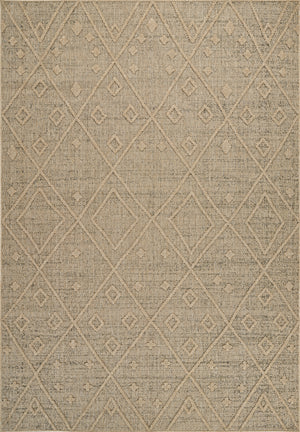
Polypropylene (olefin) is the workhorse. It is solution-dyed, meaning colour goes all the way through the fibre rather than sitting on the surface, so it resists both fading and bleaching. It is hydrophobic, so oil and water sit on top long enough to be blotted rather than soaking in. It handles the direct sun that pours through an open garage door on a July afternoon better than anything else at its price. Most of the outdoor rugs collection is built from exactly this fibre, and outdoor construction is what a garage really calls for.
Polyester is softer underfoot and takes richer colours, which matters if your garage doubles as a gym or a hangout space. It is stain-resistant against water-based spills but noticeably weaker against oil, which it will absorb and hold. Use it in a clean garage, not a working one.
Machine-washable synthetics are the most practical option for a garage that sees real mess. Being able to pull the rug up, run it through a home washer, and put it back is worth more than any stain-resistance claim. Browse the machine washable rugs range and check the washing machine guide for load and temperature limits before you buy.
Jute and natural fibres are the ones to avoid. Jute absorbs moisture, wicks stains, and rots against a damp slab. Save the jute rugs for a dry living room where they belong.
Wool deserves a mention only to rule it out on cost. It performs well and is naturally flame-resistant, which is genuinely useful near a welding bench, but putting a wool rug where a transmission might leak on it is an expensive decision.
Material Comparison at a Glance
| Feature | Polypropylene | Polyester | Machine-Washable Synthetic |
|---|---|---|---|
| Oil / grease resistance | Excellent — blots off | Poor — absorbs and holds | Good — washes out |
| Fade resistance in direct sun | Excellent (solution-dyed) | Moderate | Moderate to good |
| Moisture tolerance on concrete | Excellent | Moderate | Excellent (fully dryable) |
| Underfoot comfort | Moderate, low-pile | Soft, plusher | Soft to moderate |
| Cleaning method | Hose off, air dry | Spot clean only | Home washing machine |
| Typical lifespan in a garage | 5–8 years | 2–4 years | 3–6 years, more washes |
| Price for a 5×7 | $79–$129 | $69–$109 | $89–$149 |
If you only take one row from this table, take the oil row. It is the single variable that separates a garage rug that looks fine in year three from one you throw out in month eight.
Sizing a Rug to a Garage Bay
Garages are not sized like rooms, so the usual living room sizing rules do not transfer. Work from the function instead.
A single-car bay is typically 10 to 12 feet wide by 20 to 24 feet deep. You are almost never covering that entire footprint, and you should not try to — a rug under a parked car traps heat from the exhaust and tires. Instead, cover the walking zone along the driver's side. A runner rug in a 2×6 or 2×8 gives you a clean path from the car door to the house door, which is where 90 percent of your garage foot traffic actually happens.
A workbench zone wants a rug roughly 2 feet deep by the length of the bench, so a 2×6 runner suits a standard six-foot bench almost exactly. This is the highest-value rug in the whole garage: it is the spot where you stand longest, and where dropped tools most need something to land on.
An entry transition — the door between garage and house — deserves its own small rug to catch grit before it reaches your interior floors. A doormat or a 3×5 handles this. If you want the transition to feel deliberate rather than utilitarian, a 3×5 area rug in a mid-tone grey reads far more finished.
For a garage converted to a gym, studio or hangout, size it like a room: a 5×7 anchors a seating or equipment zone, and an 8×11 covers most of a single bay wall to wall.
Colour Choices That Hide Garage Reality
Garage floors get dirty, and colour is your cheapest defence. Mid-tone greys are the most forgiving shade you can pick — dark enough to hide oil speckle, light enough that they do not show every fleck of dust and sawdust. The grey rugs range covers most of the useful spectrum.
Avoid the extremes. Pure black shows dust and lint in a way that surprises people, and it absorbs heat, which is a real consideration if your garage hits 100°F in August. Ivory and cream will look excellent for approximately two weeks. Save the ivory and cream rugs for a bedroom.
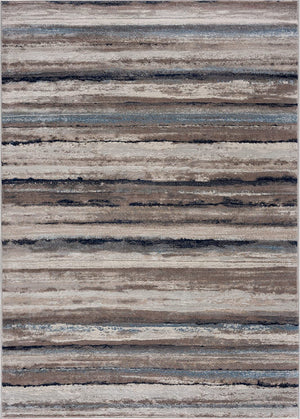
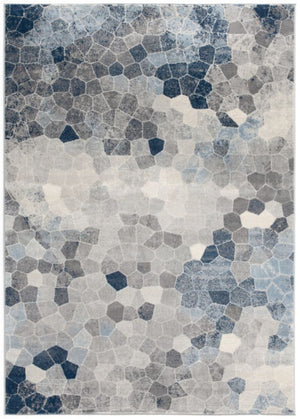
Multi-tone and heathered patterns outperform solids at hiding wear, because the eye reads variation as pattern rather than as stains. A flecked or distressed design in the plain rugs or transitional rugs collections gives you camouflage without looking busy. If your garage doubles as a living space, warmer rust and terracotta tones hide dirt nearly as well and feel far less industrial.
Pile Height: Lower Is Almost Always Right
Pile height is the specification most people get wrong in a garage. Anything above about half an inch becomes a problem fast.
A flatweave or low pile under 1/4 inch is ideal. It lets a rolling tool chest, a floor jack, or a wheelchair cross without catching. It sweeps clean. It dries fast. It does not trap metal shavings the way a longer pile does — and metal shavings embedded in a rug are both impossible to vacuum out and a genuine hazard for bare feet and pets.
A mid pile of 1/4 to 1/2 inch is the practical maximum, and only worth it in a garage that is more hangout than workshop. It adds real standing comfort at the workbench.
Shag and high pile are a mistake here. They trap everything, cannot be swept, and take days to dry. The shaggy rugs collection is wonderful — in a bedroom.
The one exception is an anti-fatigue application. If you stand at a bench for hours, comfort beats maintenance, and a thicker rug over a dense pad is genuinely easier on your back and knees.
Anchoring: The Step Most People Skip
A rug that slides on concrete is a trip hazard and will destroy itself from underneath. Anchoring is not optional in a garage.
A quality rug pad is the correct answer for anything 3×5 and larger. It stops lateral movement, adds a cushioning layer that absorbs dropped-tool impact, and — importantly on concrete — creates a small air gap that helps the slab breathe. A premium rug pad runs $29 to $79 depending on size and is the highest-return $40 you will spend on the whole project. Our guide on why you need a rug pad covers the full case.
For runners along a bench, double-sided rug tape at the two short ends is usually enough, though be aware that adhesive can leave residue on sealed or epoxy-coated concrete. Test a small corner first.
If your garage floor is epoxy-coated or polished, non-slip backing becomes even more critical — those surfaces are dramatically slicker than bare concrete, and a rug will skate on them.
Cleaning and Maintenance Through the Seasons
Garage rugs need a different routine than indoor rugs, and it is mostly seasonal.
Weekly, shake or sweep. A stiff push broom pulls grit out of a low pile better than a vacuum does, and grit is what actually kills a rug.
For oil and grease, act fast and blot — never rub, which drives oil deeper into the fibre. Cover the spot with cornstarch or cat litter, leave it 20 minutes to draw the oil up, then sweep it off and treat with a degreaser. Polypropylene will usually release the stain completely if you catch it within a day.
Twice a year, take the rug outside and hose it down. Prop it over a fence or sawhorses and let it dry completely on both sides before it goes back on the slab. A rug returned damp to concrete will mildew. Our complete guide to cleaning an area rug covers deeper cleaning methods, and if you went with a washable option, are area rugs machine washable explains what survives a home washer.
In winter, road salt is the hidden enemy. Salt crystallises in the fibre and cuts it from the inside as the rug flexes. Rinse salt-exposed rugs with plain water before storing them for the season.
What You Should Expect to Spend
Garage rugs are one of the few places where the budget option is often the correct option, because you are buying a consumable.
A doormat or small entry rug runs $29 to $59. A 2×6 or 2×8 workbench runner sits at $49 to $129. A 3×5 or 4×6 for an entry or equipment zone falls between $39 and $79 — see the 4×6 range for the sweet spot. A 5×7 for a converted bay is $79 to $149, and a full 9×12 or larger runs $149 to $399. Add $29 to $79 for a pad.
A realistic full garage setup — entry mat, bench runner, and one zone rug with a pad — lands between $150 and $280. Rug Branch ships free, so the price you see is the price you pay, and returns are straightforward if the size does not work out once it is down on the floor.
Buy the size you need rather than the size you wish you needed. An oversized rug in a garage collects more dirt, is harder to lift for cleaning, and gets moved constantly.
Frequently Asked Questions
Q: Can you put an area rug on a garage floor? A: Yes, provided you choose the right construction. Use an outdoor-rated, low-pile rug in polypropylene or a machine-washable synthetic, and pair it with a breathable non-slip pad rather than a solid rubber backing. The two things that ruin garage rugs are trapped moisture against the concrete and oil soaking into an absorbent fibre. Avoid jute, wool, and anything with a pile over half an inch.
Q: Will a rug damage or stain my concrete or epoxy floor? A: A breathable rug over a proper pad will not, but a solid rubber-backed rug can. Rubber traps vapour rising through the slab and can leave a permanent dark outline, and on epoxy coatings some rubber compounds react with the finish and cause yellowing. Lift the rug two or three times a year to let the floor dry, and test any adhesive tape on a hidden corner first.
Q: What size rug works best in a garage? A: Match the rug to the activity, not the room. A 2×6 runner covers a standard six-foot workbench, a 3×5 handles the door between garage and house, and a 5×7 or 8×11 suits a bay converted to a gym or hangout. Do not run a rug under a parked vehicle — tire and exhaust heat degrades synthetic fibres and the weight crushes the pile permanently.
Q: How do I get motor oil out of a garage rug? A: Blot immediately without rubbing, then cover the stain with cornstarch, baking soda, or cat litter and leave it 20 minutes to absorb what soaked in. Sweep the powder away and apply a citrus or dish-soap degreaser, working from the outside of the stain inward. Rinse and dry fully. Polypropylene usually releases oil completely if treated within 24 hours; polyester often will not.
Q: Are outdoor rugs good for garages? A: They are the single best category for it. Outdoor rugs are built for exactly the conditions a garage creates — UV exposure through an open door, temperature swings, moisture, and abrasive grit. They are solution-dyed for fade resistance, they hose clean, and they dry quickly. For most people, shopping the outdoor collection is a faster route to the right garage rug than shopping indoor categories.
The Bottom Line
Three things decide whether a garage rug lasts. First, material — polypropylene or a washable synthetic, never jute or untreated natural fibre, because oil resistance is what separates a five-year rug from a five-month one. Second, pile height — stay under half an inch so the rug sweeps clean, dries fast, and does not swallow metal shavings. Third, anchoring — a breathable pad stops the slide, cushions dropped tools, and lets the concrete underneath breathe.
Get those right and a $100 rug will outlast three careless ones. Ready to start? Browse the outdoor rugs collection for garage-ready construction, or check the best sellers for the sizes that move fastest. Free shipping, easy returns, and no surprise charges at checkout.